Article
How to Build a Single Source of Truth for Your Company (7 Steps)
A single source of truth gives every important question one trusted answer, for people and AI. How to build one in seven steps and keep it current.

Most companies don’t have an information problem. Actually, they have a trust problem. The answer to “what’s our refund policy?” exists, in four places, and three of them are outdated. So, people do the sensible thing and ask a colleague in chat, and the colleague answers from his or her memory.
This plays out at almost every company, and the usual fixes don’t last. It used to be a real annoyance, but now, with AI, it’s a liability. An AI assistant will repeat whatever it finds first – with total confidence. Here’s how to fix it.
What is a single source of truth?
A single source of truth (SSOT) is one agreed, authoritative place for each type of company information. It includes a named owner and a definitive status. When someone asks “what’s our refund policy?” or “why did we delay the mobile launch?” there’s one place that holds a single, current answer.
The SSOT term comes from data engineering, where it means that every piece of data is stored once – and referenced everywhere else. For companies, the idea is broader. It covers four kinds of information:
- Knowledge: policies, how-to guides, product documentation.
- Evidence: customer feedback, research, support themes.
- Decisions: what was decided on and why.
- Plans: roadmaps, goals, owners.
It’s also worth defining what a single source of truth is not:
- One tool for everything. Team members don’t need to use the exact same tools. Your code can stay in your repository and your tickets in your issue tracker.
- A dumping ground for stale information. Copying every file into a new wiki just moves the mess.
- A one-time project. Knowledge is dynamic. Without defined owners, it starts to decay the week you launch it.
Why your company needs one
Scattered knowledge costs time, causes rework, and misleads AI. The research on lost time has been consistent for more than a decade:
- Nearly a fifth of the week. The McKinsey Global Institute found that knowledge workers spend nearly 20% of their workweek looking for internal information or tracking down colleagues who can help them (The social economy, 2012).
- A quarter of the time. Atlassian’s State of Teams 2025, a survey of 12,000 knowledge workers and 200 executives, found that leaders and teams waste 25% of their time searching for answers.
AI makes this more urgent – not less. Atlassian’s State of Teams 2026 found that 85% of knowledge workers use AI, but only 29% have built AI use into their daily work. One common reason is that AI can’t find an answer that employees trust. If your company wiki says one thing and a slide deck says another, AI won’t know which is right.
Here’s a hypothetical example of what this looks like in practice. Take a 120-person company where each employee loses three hours a week searching for or double-checking information. That’s 360 hours a week – roughly nine full-time people’s worth of capacity. If you recover even a third of it, you’ve gained three people, every week, without hiring anyone new.
Do you know where your company stands? Before you start building, take NuHQ’s free Sync Index. It has six questions and takes about two minutes, and you’ll get a score from 0 to 100, your stage (from Siloed to Self-syncing), and the one area holding the rest back. You can also enter your headcount and hours to estimate how much time your team spends searching for information and what it could be costing your company each year.
How to build a single source of truth in 7 steps
Here’s the short version: audit, define your information types, choose one home for each, assign owners, migrate selectively, connect decisions and evidence, and make it the default.
Here’s the long version:
Step 1: Audit where your company knowledge lives today
Map every place your team members store and look for information. Specifically, list each tool, what’s in it, who uses it, and how current it is.
Next, ask five people from different teams: “Where did you last look for an answer, and did you find it?” Then, pull the most-repeated questions from your chat channels and help desk. Create a spreadsheet with four columns: source, content type, owner, last updated.
You can expect to find somewhere between 8 and 15 sources, including personal drives, chat threads, meeting notes, slide decks, and at least one abandoned wiki.
Step 2: Define your information types
Group your content into a small set of information types. Ideally, each of these answers a different kind of question. Here’s a practical starting point:
- Company knowledge: policies, handbooks, how-to guides, org information.
- Product knowledge: specs, documentation, release notes.
- Customer evidence: feedback, interview notes, support themes, research.
- Decisions: what was decided, why, by whom and when.
- Plans: goals, roadmaps, projects, owners, dates.
Keep your list to five to seven types of information. If you have more, people most likely won’t remember which is which.
Step 3: Choose one home for each type of information
For every type, pick exactly one canonical home. Everything else either links to it or gets archived.
This is where you might start to see some real trade-offs. Some teams keep specialized tools and connect them. However, others consolidate several types into one platform so the context stays linked.
Here are the common approaches:
| Approach | How it works | Strengths | Watch out for |
|---|---|---|---|
| Traditional wiki (e.g., Confluence, Notion) | Pages and folders | Familiar, flexible, works for long documents | Goes stale without owners; decisions and evidence usually live somewhere else |
| AI search across tools (e.g., Glean) | A search and AI layer over the tools you already have | No migration; finds content where it sits | Finds the contradictions too; doesn’t fix ownership or structure |
| Connected company HQ (e.g., NuHQ) | One platform where knowledge, evidence, decisions and plans link together | Context stays connected; AI answers from one trusted source | Requires a deliberate migration and new habits |
| Spreadsheet and shared drive | An index sheet pointing to files | Cheap and fast to start | Challenging to maintain; weak permissions; poor for AI |
Step 4: Give everything an owner and a review date
Every page, record, or collection needs a named owner and a review schedule. Ownership is the best predictor of whether a source of truth stays true.
- Owner: a person, not a team. “People Ops” isn’t an owner. “Jane Doe, People Ops” is.
- Status: draft, current or archived, visible at the top of the page.
- Review schedule: quarterly for policies, monthly for plans, whenever something changes for product docs.
Step 5: Migrate your information selectively
Most of these projects stall at migration because teams try to move everything at once. So, start with the most-asked questions and move only the content that answers real ones. Then:
- Take the top 20–30 repeated questions from your Step 1 audit.
- For each question, find the best existing answer. Then, rewrite it, if needed, and publish it in its new home.
- Redirect or archive the old copies, with a link to the new location.
- Leave everything else where it is, read-only, until someone needs it.
Most people dread switching tools – for good reason. A migration that drags on for months loses goodwill internally, so keep the first wave small enough to finish in a few weeks.
Step 6: Connect decisions and customer evidence
A source of truth that only holds documents tells people what, not necessarily why. Take the next step to connect decisions to the evidence behind them so that anyone can understand the reasoning.
To start, create a lightweight decision log: track what was decided, the options that were considered, the evidence, the owner, and the date. For product teams, link customer feedback directly to the roadmap items it supports.
This is the gap NuHQ Products is built to close. Customer evidence, product decisions, roadmaps, and releases live together, so the reasoning stays connected to the plan.
Step 7: Make the source of truth the default for people and AI
Ensure that the source of truth is the first place every question goes – for both people and AI assistants.
- Point to it in your company onboarding and answer questions in chat with a link instead of a paragraph.
- Direct your AI assistant only at the canonical sources, and require citations in its answers.
- Respect permissions, so AI never shows someone content they shouldn’t see.
- Track the questions AI can’t answer. Each one is a gap to fill to build out your source of truth.
NuHQ Knowledge is built for this layer, with AI at the core rather than added on top. To learn more, check out the NuHQ Knowledge Tour.
How to tell if your system is working
Measure whether people find trusted answers faster and stop asking the same questions. Usage counts alone won’t tell you that, so track four things each month:
- Time-to-answer for your top 20 questions. Ask a few employees to time a search.
- Repeat questions in chat and the help desk. These should go down.
- Stale content rate: the share of pages past their review date.
- AI answer acceptance: how often people accept an AI answer without checking elsewhere.
For a more comprehensive view of how effectively knowledge moves through your company, our Organizational Sync Maturity Model scores six dimensions – from finding answers to giving AI company context.
Common mistakes
The most common mistake is treating a single source of truth as just another software purchase, rather than a habit. The tool matters, but ownership and workflow matter even more.
Here are the most common mistakes companies make when building a single source of truth:
- Migrating everything at once. You import years of outdated content and bury the good answers.
- No owners. Content without named owners decays within months.
- Parallel sources. If the old wiki stays editable, people will keep using it.
- Documents without decisions. People can see the plan but not the reasoning. So, the same debates resurface.
- Pointing AI at the mess. AI search over contradictory sources spreads the contradictions even faster.
A single source of truth is also the foundation of an AI-native company. Laura Nelson’s explainer – What Is an AI-Native Company? – discusses why shared, trusted context matters more than which AI model your company chooses.
See a connected source of truth in action
Our own public help center runs on NuHQ Knowledge, so you can see a live source of truth before talking to anyone. To learn more, take the Knowledge tour, or join the waitlist for the private beta.
Key takeaways
- A single source of truth is one authoritative home for each type of company information, with a named owner and status.
- Scattered knowledge is expensive. McKinsey found people spend nearly 20% of the week looking for the right information, and Atlassian puts it at 25%.
- Build it in seven steps: audit, define types, choose destinations, assign owners, migrate selectively, connect decisions and evidence, and make it the default.
- AI makes a single source of truth more important, because AI repeats whatever it finds, whether it’s right or wrong.
Put this into practice with NuHQ Products
Product work linked to the decisions and knowledge behind it. The beta is opening to teams in waves.
Frequently asked questions
What is a single source of truth in a company?
A single source of truth (SSOT) is one agreed-upon, authoritative place where each type of company information lives, with a named owner and a clear status. People and AI tools go there first, and every other copy links back to it. An SSOT doesn’t require one tool for everything. It requires one trusted answer for every important question within your company.
Do I need one tool to have a single source of truth?
No. A single source of truth means one authoritative home for each type of information, not one application for everything. Code can live in your repository and tickets can stay in your issue tracker. What matters is that policies, decisions, customer evidence, and plans each have one canonical location, that copies link to it, and that everyone knows where to look for answers.
How long does it take to build a single source of truth?
It depends. A focused team can stand up a working single source of truth for its FAQs in a matter of a few weeks. Start with the 20 to 30 questions people ask most, migrate only the content that answers them, and assign owners. Full company coverage takes longer, but the early wins come from depth in a few high-traffic areas.
How do you keep a single source of truth from going stale?
Give every page or record a named owner and a review date. For example, review policies on a quarterly basis, and flag out-of-date content automatically. Most importantly, make updating the source part of the work itself: log decisions when they’re made, not after the fact.
How does AI change the single source of truth?
AI raises the stakes. Specifically, AI assistants answer from whatever content they can reach, so contradictory or outdated documents produce confident wrong answers at scale. By contrast, a clean, owned single source of truth lets AI cite trusted sources, respect permissions, and answer accurately. AI can also help maintain your single source of truth by flagging duplicates, gaps, and conflicting content.
Sources
Written by
LinkedIn profileRelated reading
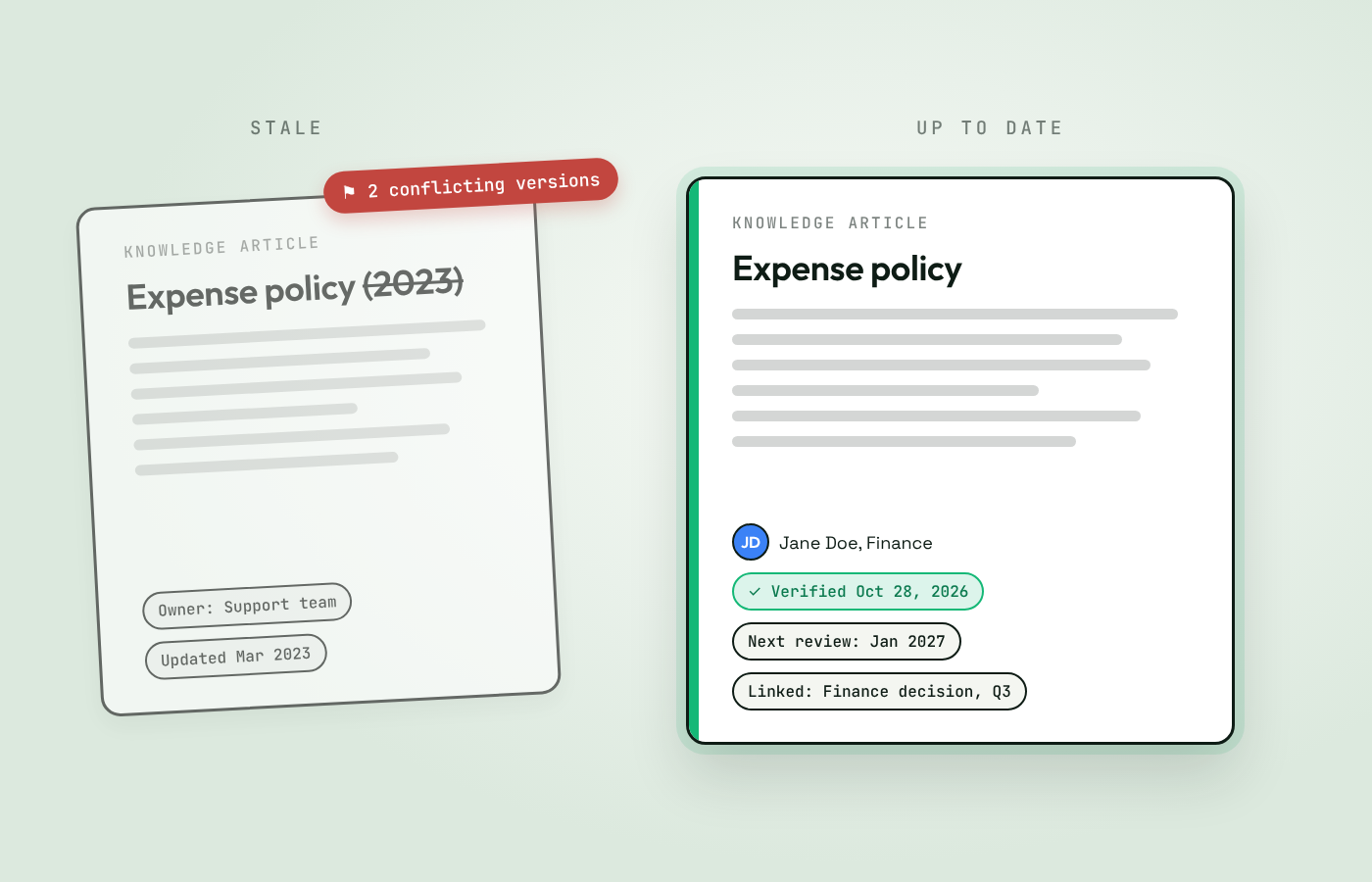
How to Keep Your Knowledge Base Up to Date (and Stop It From Going Stale)
Knowledge bases go stale fast. How to keep yours up to date with owners, review dates, updates in the flow of work, and signals that flag outdated content.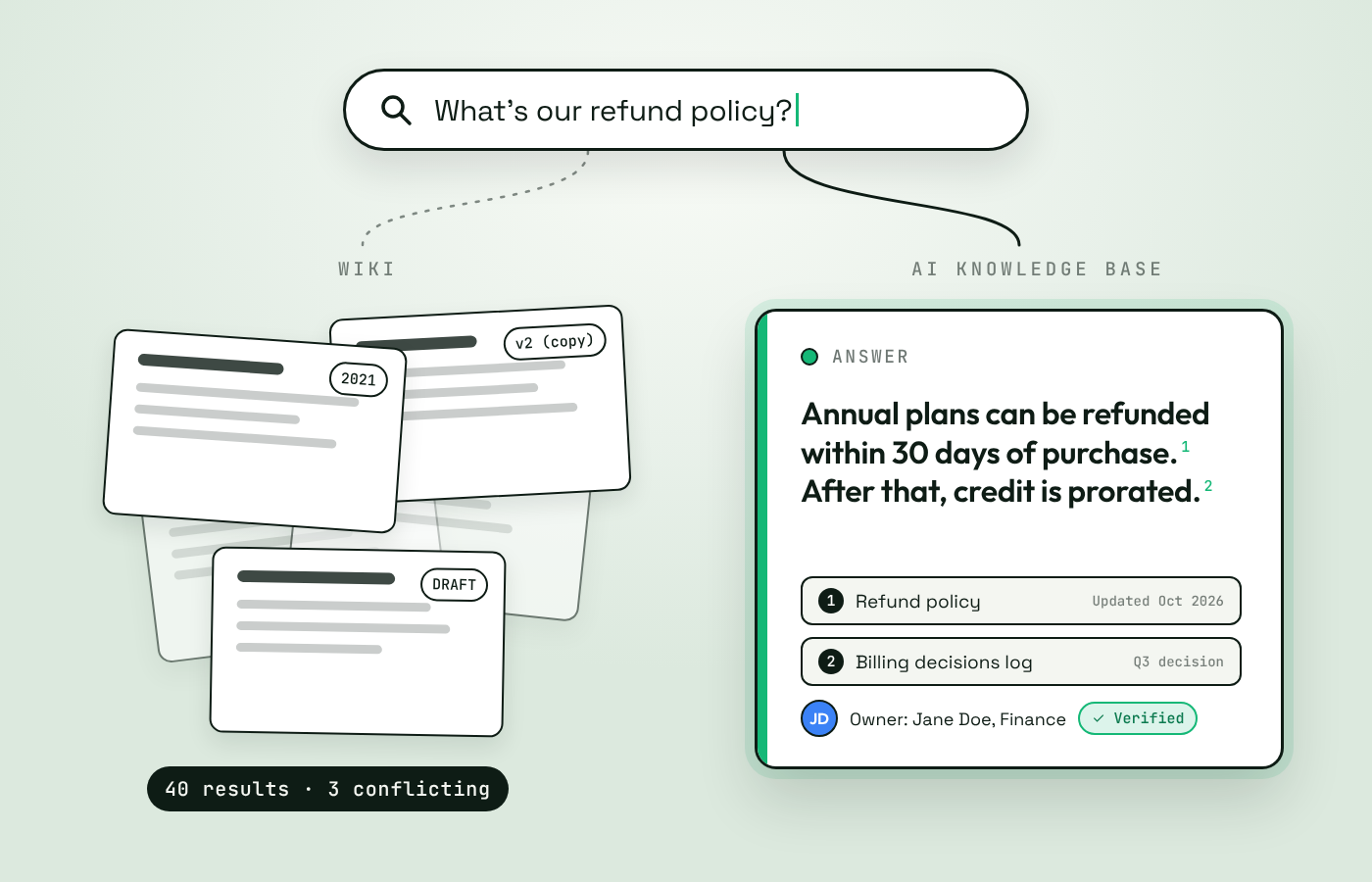
AI Knowledge Base vs Wiki: Should You Replace Your Company Wiki?
AI knowledge base vs wiki: how they differ, what AI changes, the real risks, and a five-question test for whether to replace, upgrade, or keep your wiki.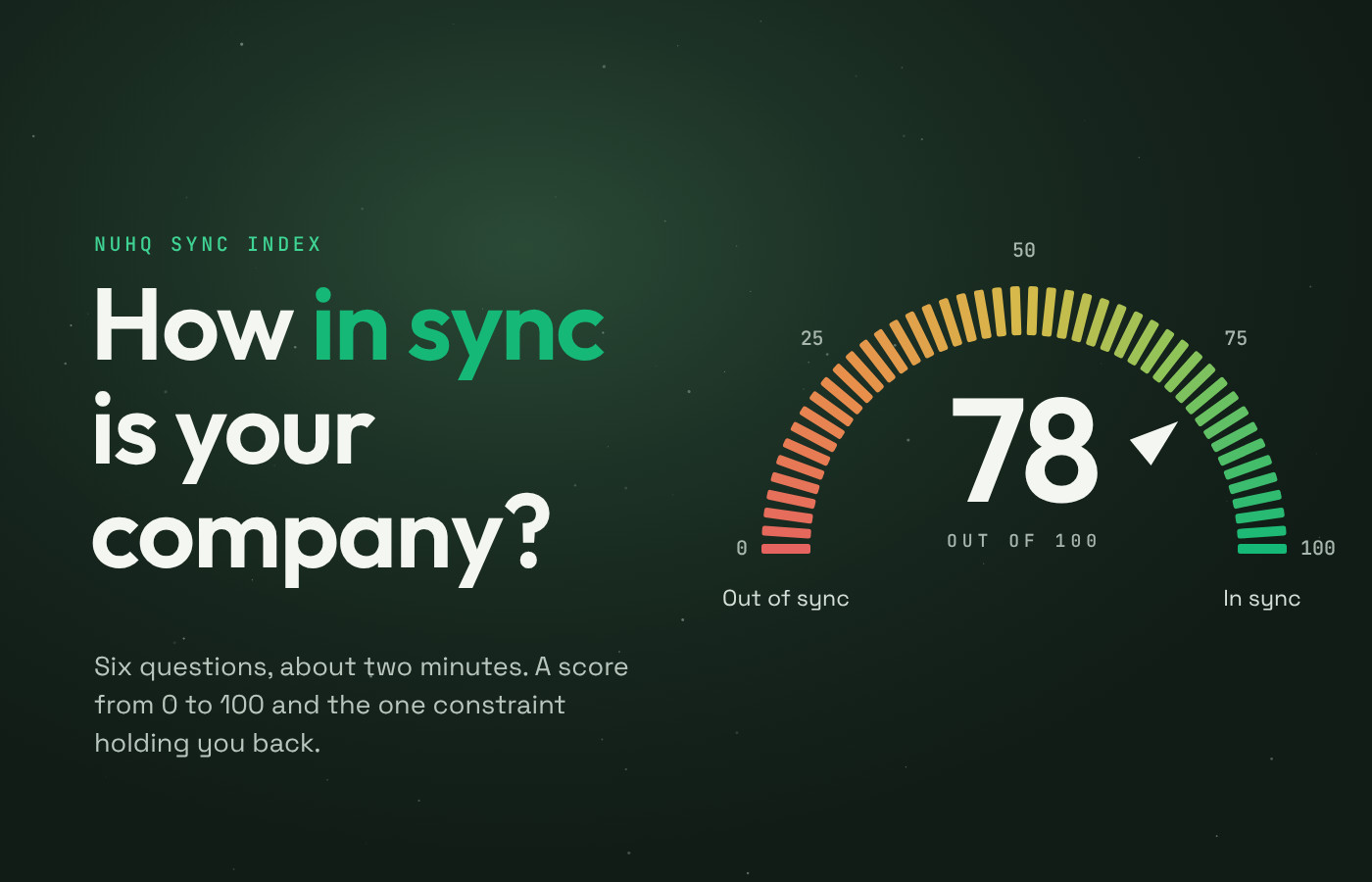
The Organizational Sync Maturity Model: How to Measure Whether Your Company Is in Sync
How well does knowledge move through your company? Use the Organizational Sync Maturity Model to score six dimensions and find what to fix first.


