Article
What Is an AI-Native Company? Definition, Traits, and How to Become One
An AI-native company designs its work so people and AI share the same trusted context. The definition, six traits, and a 90-day plan to get there.

I’ve built marketing departments at four startups. NuHQ is the first one built with AI from the ground up.
As a marketer, I leverage AI tools across a range of projects. Before we published a single word, I built a brand context guide that AI reads before creating every draft. It includes our positioning, who we write for, and the claims we don’t make. Our first drafts now start on-brand instead of generic – a much better foundation.
However, what makes it work isn’t just the tools. Instead, it’s that we decided early on what AI does, what people need to do, and where our company’s shared context lives.
Most companies haven’t made those decisions yet, and you can see it in the hiring process for non-technical talent. For example, Emily Kramer of MKT1 recently analyzed more than 1,100 marketing job posts. Among B2B startups, only 47% of posts asked for AI skills. At AI-native startups, 56% didn’t ask for AI skills. Also, just 8% of companies asked candidates to show how they actually use AI.
Take note: that doesn’t mean those teams aren’t using AI. Instead, it means they don’t have a shared definition of what good AI use looks like. The gap between using AI and being built for it is what “AI-native” is about.
What is an AI-native company?
An AI-native company assumes AI is part of the team and day-to-day tasks. AI shows up in how work is planned, how knowledge is institutionalized, how decisions are made, and how results get checked. This goes beyond using a chatbot.
The term is derived from “cloud-native.” However, cloud-native companies didn’t just move their servers into someone else’s data center. They went beyond, designing their software around flexible infrastructure from the beginning. AI-native companies work from a similar philosophy.
Unfortunately, buying AI licenses doesn’t make a company AI-native. Redesigning the work so that AI has the context, permissions, and responsibilities to contribute to it does.
Here’s a working definition:
An AI-native company is an organization whose workflows, knowledge and decisions are designed so that people and AI work from the same trusted context. While people own the judgment calls, AI handles the retrieval, synthesis and routine work.
For a company to be AI-native, these three characteristics should be true:
- AI should be designed, not bolted on. AI is part of the foundation, not an add-on.
- It should have shared, trusted context. AI is only as good as the knowledge it can access. If the most current knowledge is scattered across 14 tools, the AI will be confidently wrong.
- The company should have clear accountability. People still drive decision-making. AI-native doesn’t mean AI decides what your company – and its people – do next.
Why is everyone talking about AI-native companies now?
It’s a hot topic because nearly every company now uses AI, but few see meaningful returns.
- AI adoption is nearly universal. About 88% of organizations used AI in at least one business function last year, according to the 2026 AI Index from Stanford HAI.
- The impact of using AI is rare. In McKinsey’s The state of AI in 2026, only about 6% of respondents qualify as AI high performers, and 37% attribute any EBIT impact to AI.
- Most AI use is pretty shallow. Atlassian’s State of Teams 2026 found that 85% of knowledge workers use AI, but only 29% have built it into their daily workflows.
So, while most companies are AI-enabled, very few are AI-native. McKinsey’s data surfaces what separates them: nearly 75% of high performers say they fundamentally redesigned workflows around AI. The tools didn’t produce the result, but the redesigned work did.
In an April 2025 memo, Shopify CEO Tobi Lütke wrote that “reflexive AI usage is now a baseline expectation at Shopify” and asked teams to show why AI couldn’t do a job before building out their teams (Digital Commerce 360). That’s a clear indication of how the company operates, not just another tool.
AI-native vs AI-enabled: what’s the difference?
An AI-enabled company adds AI to the work it already does. An AI-native company redesigns its work around AI.
| AI-enabled company | AI-native company | |
|---|---|---|
| Starting point | Existing processes with AI tools added | Processes designed with AI as a participant |
| Where knowledge lives | Scattered across wikis, docs, chat and inboxes | One trusted, connected source people and AI share |
| Role of AI | An optional assistant or chatbot that people choose to use | A defined contributor at specific steps |
| Decisions | Made in meetings, but the reasoning sometimes gets lost | Logged with evidence, so anyone can trace the rationale |
| Customer evidence | Buried in support tickets and call notes | Linked to the decisions and plans it shaped |
| Skills and hiring | “Familiar with AI tools” on the job post | A shared, demonstrated standard for productive AI use |
| How success is measured | License counts and usage | Cycle time, decision quality, capacity per person |
| Typical failure | Generic or wrong answers from stale data | Over-automation without human review |
Most of these qualities have nothing to do with models. They’re about context, structure, people, and accountability. As a result, a better model rarely turns an AI-enabled company into an AI-native one.
Why it’s easier to start AI-native than to become AI-native
I think about this quite a bit, because I’m watching it from the inside.
We started NuHQ in 2026 with all of the most powerful AI tools at our disposal. As a result, nobody had to unlearn something from a previous job. Also, there was no five-year-old wiki to clean up, no software contracts to wait out, and no individual or team determined to continue habits from the past decade. We formed our habits and workflows with AI already in them.
Unfortunately, established companies don’t get this type of clean start. To become AI-native, they have to change at least three things simultaneously:
- Tools. Often, they’re working with systems chosen years ago by people who don’t use them every day. They’re dealing with contracts that renew on their own schedules.
- Behaviors. This is a big one that affects all areas of work. It relates to how people search for answers, write documents, make decisions and hand off work. Human habits are older than any tool or technology, and they’re more difficult to change.
- Roles and expectations. What a job description asks for, what a leader or manager rewards, and what “good work” means when AI does the first draft.
It’s often a change management problem more than a technology problem, and it’s why so many AI rollouts stall when “everyone has a license.”
However, incumbents have something a startup doesn’t: years of context. This includes customer conversations, past decisions, and institutional knowledge about what worked and what didn’t. A startup has to build all of this from scratch.
An established company that connects all its knowledge, and gives AI a trusted view of it, can move faster than any new competitor. The hard part isn’t the AI – it’s the switch. It helps to make that switch one workflow at a time.
Six traits of an AI-native company
AI-native companies tend to share six traits. Audit your own company against this list.
- One trusted knowledge layer. Policies, product context, customer evidence and plans live in one connected place, and AI answers from that source with citations.
- Decisions tied to evidence. Every meaningful decision records what was decided, why, by whom, and on what evidence. A simple decision log is enough to get started.
- A defined job for AI in each workflow. Instead of “everyone can use the chatbot,” each workflow names specifically what AI does: summarize interviews, draft a spec, flag conflicts, and answer policy questions.
- A shared definition of good AI use. Teams agree on what skilled AI use looks like and hire for it. While tech teams have incorporated this into their hiring assessments, I think the same standard is coming for non-technical roles, too.
- Transparent governance. People know what data AI can see, which models it uses and when a human needs to review its output.
- Outcome metrics. Define the goals of AI and measure them. For example, success can be measured in cycle time, rework, and decisions made with evidence – not in active seats.
Why context matters more than the model
AI models are available to everyone, but your company’s knowledge isn’t. As a result, two companies using the same model will get very different results, depending on whether the AI can see accurate, current, permissioned information.
Andreessen Horowitz general partner David Haber makes the same point in Context Is King: “AI dramatically expands what’s technically possible, but it doesn’t tell you what’s actually useful.” He says that the companies that last are “the ones that embed context deeply.”
I see this every day in marketing. For example, AI with no context writes generic copy. On the other hand, AI that can read our positioning, understand our audience, and incorporate the claims we’ve approved writes something I can edit into a finished piece. Same model, very different results.
Inside a company, context comes in four kinds:
- Knowledge: how things work, policies, product documentation.
- Evidence: what customers said, did, and asked for.
- Decisions: what was chosen, what was rejected, and why.
- Plans: what’s being built, by whom, and when.
When those four levels of context live in separate tools with separate permissions, AI can only stitch fragmented information together. When they’re connected, AI can answer a complex question like “Why did we drop the enterprise tier from the Q3 roadmap, and which customer calls supported that?” This is the type of question we built NuHQ to answer.
What an AI-native company looks like in practice
Here’s a hypothetical example of a 60-person B2B software company:
Before (AI-enabled). Product managers spend Monday mornings digging through call recordings, support tickets, and a stale wiki to prepare for the roadmap review. New hires ask the same questions in Slack every week. Everyone has a license to an AI chatbot, but the answers are generic because it can’t see anything internal. A pricing decision from last quarter enters the debate again because context was lost.
After (AI-native). Customer evidence lives in one place and is linked to the product decisions it helped to shape. The knowledge base is the single source AI answers from, with citations. AI drafts the weekly roadmap brief from the evidence, and a product lead reviews and edits it in 20 minutes, rather than three hours. The pricing decision has a log entry, so that debate takes five minutes.
Take note: the model didn’t change between those two scenarios. Instead, the way the company organized its knowledge, and the way its people worked with AI, did.
How to become an AI-native company in 90 days
It’s challenging, but not impossible. To start, don’t roll out all of your new tools company-wide. Instead, redesign one workflow at a time around shared context. A focused 90-day plan will work for most teams. Here’s how:
- Pick one high-friction workflow (weeks 1–2). For example, roadmap planning, triage of customer feedback, or employee onboarding and policy questions. Write down how it works today and where people lose time and productivity.
- Consolidate its knowledge (weeks 3–5). Move the authoritative content for that workflow into one trusted place. Then, archive or label what’s stale and decide who owns each area.
- Capture decisions and evidence (weeks 4–6). Start a decision log, and link customer evidence to the right decisions.
- Give AI a defined job (weeks 6–8). For each step, write one sentence: what AI does, what a person reviews, and what AI should never do.
- Define what good looks like for people (weeks 6–8). Agree on the AI skills this workflow needs, show people examples and update the job descriptions for the roles involved. This is where a lot of the change management happens.
- Establish governance (weeks 6–8). Confirm permissions and model choices, and review your rules. Then, make them visible to everyone affected.
- Measure, then expand (weeks 9–12). Compare cycle time, rework and time-to-answer against your starting point. Then, pick the next workflow.
Common mistakes on the way to AI-native
Often, companies treat a transition to AI-native as a procurement project. As I mentioned, buying licenses makes you an AI-enabled company. But changing how knowledge, decisions and people’s habits work transforms your company into an AI-native organization.
- Linking AI to messy data. AI pointed at contradictory documents just surfaces the contradictions faster. So, take time to clean up the source first.
- Hiring for “uses AI” without defining what that means. One team’s “AI-forward” contributor is building agents for the whole team. Another’s is using a chatbot for first drafts. Both can check the same box on a job post.
- Skipping governance. Shadow AI grows when the official tools don’t have the context that people and teams need.
- Automating judgment. Keep people accountable for their decisions, especially ones that affect customers or revenue.
- Measuring usage instead of outcomes. Weekly active users tell you about adoption, not necessarily their impact.
- Going company-wide on day one. Start small. One redesigned workflow will beat ten half-adopted tools.
See what an AI-native company HQ looks like
NuHQ is a suite of connected apps for knowledge, product management, projects and communication, built on one shared context layer with AI at the core. Take the Knowledge tour to see how it works with no sales call, or join the waitlist for the private beta.
Key takeaways
- An AI-native company designs its workflows, knowledge and decisions so that people and AI share the same trusted context. Ultimately, people are still held accountable for judgment.
- Most companies are AI-enabled, not AI-native. McKinsey finds that only about 6% are AI high performers, and Atlassian finds only 29% of knowledge workers have built AI into their daily work.
- It’s easier to start AI-native than to become AI-native. Established companies have to change tools, behaviors, and expectations simultaneously, but they also have years of context that a startup doesn’t have.
- Start with one workflow. Consolidate its knowledge, define what AI needs to do, and what good looks like for people. Then, measure outcomes over 90 days.
Put this into practice with NuHQ Products
Product work linked to the decisions and knowledge behind it. The beta is opening to teams in waves.
Frequently asked questions
What is the simplest definition of an AI-native company?
An AI-native company assumes that AI takes part in the everyday work of its people and teams. Its workflows, knowledge, and decisions are set up so that people and AI agents share the same trusted context. The opposite is an AI-enabled company, which adds AI tools on top of processes designed initially for people.
What is the difference between AI-native and AI-first?
The terms overlap and are often used interchangeably. AI-first usually describes a priority: people and teams must use AI before other options. AI-native describes how the company is built: its data, workflows, and operating model already assume that AI is part of the work. Take note: a company can declare itself AI-first in a memo. However, becoming AI-native means redesigning how knowledge and decisions flow.
Can an established company become AI-native, or only startups?
Established companies can become AI-native, but it’s more difficult than starting that way, because they have to change tools, behaviors, and expectations at once. Most companies succeed by starting with one team or workflow, consolidating knowledge into a trusted source, redesigning the work around AI, and expanding. Established organizations have an advantage with years of customer evidence and institutional knowledge that AI can leverage once it’s connected.
How do you hire for an AI-native company?
Define what good AI use means for the role, put it in the job description, and ask candidates to show their work. A useful progression runs from chatting with AI, to building your own workflows and agents, to contributing to the shared AI systems your whole team uses.
Does AI-native mean replacing employees with AI?
No. AI-native means people and AI work from shared context, with people owning judgment, accountability, and final decisions. AI handles retrieval, synthesis, drafting and routine execution. The goal is to achieve more capacity per person, not necessarily fewer people.
What software does an AI-native company need?
An AI-native company needs a trusted knowledge layer, a way to capture decisions and evidence, and AI grounded in that context – with clear permissions and transparency. Some teams assemble this across several tools, while others use a connected platform. NuHQ, for example, is an AI-native company HQ that connects knowledge, customer evidence, product decisions, and plans in one system.
Sources
Written by
LinkedIn profileRelated reading
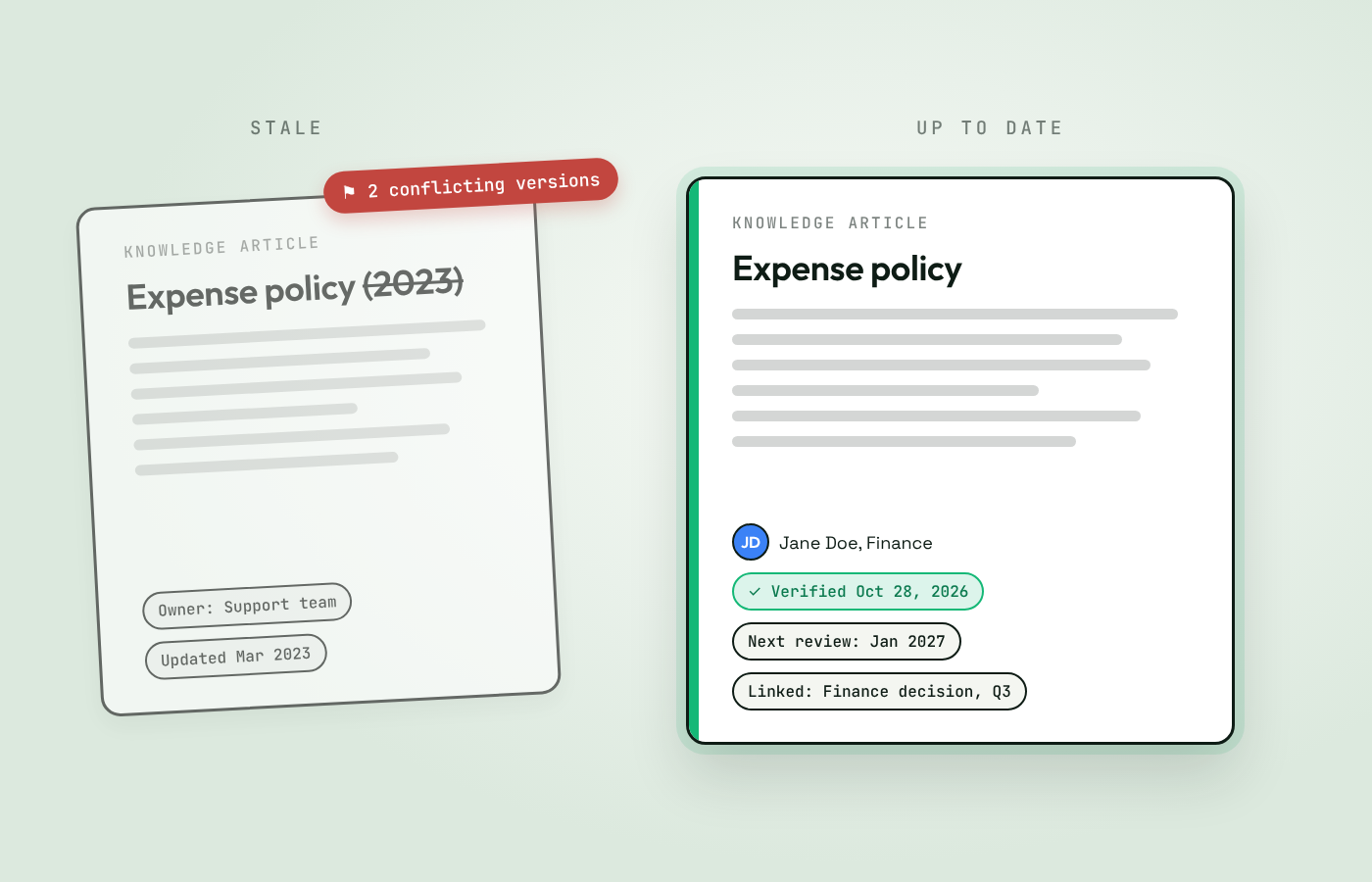
How to Keep Your Knowledge Base Up to Date (and Stop It From Going Stale)
Knowledge bases go stale fast. How to keep yours up to date with owners, review dates, updates in the flow of work, and signals that flag outdated content.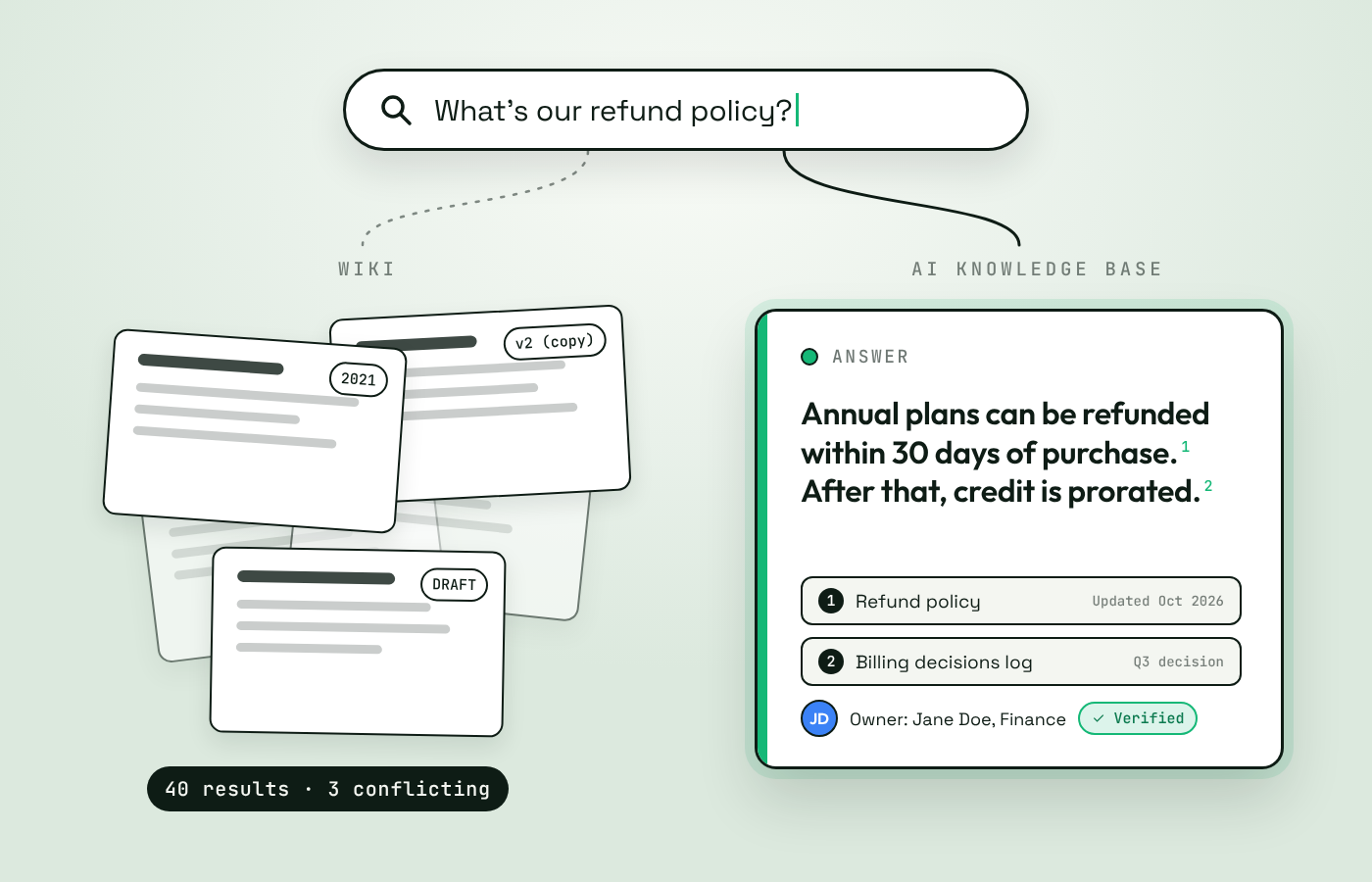
AI Knowledge Base vs Wiki: Should You Replace Your Company Wiki?
AI knowledge base vs wiki: how they differ, what AI changes, the real risks, and a five-question test for whether to replace, upgrade, or keep your wiki.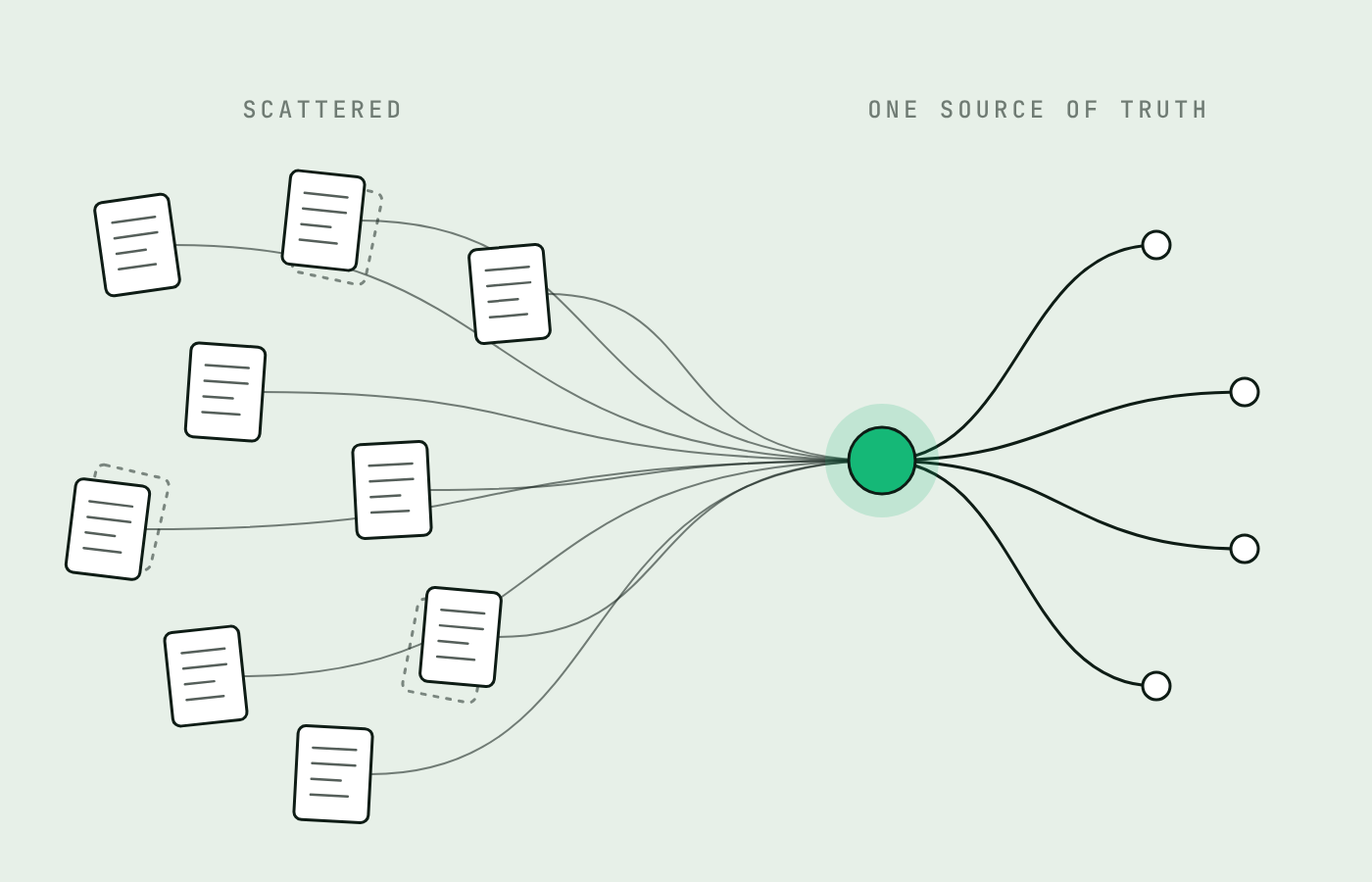
How to Build a Single Source of Truth for Your Company (7 Steps)
A single source of truth gives every important question one trusted answer, for people and AI. How to build one in seven steps and keep it current.


