Article
The Organizational Sync Maturity Model: How to Measure Whether Your Company Is in Sync
How well does knowledge move through your company? Use the Organizational Sync Maturity Model to score six dimensions and find what to fix first.

Consider the following scenarios: Leadership changes a priority on Monday. On Friday, half the company is still working on the old one. A new hire spends three weeks learning who to ask for what they need. Two teams build the same feature because neither knew the other had started.
Usually, we file these under different headings: a communication problem, a culture problem, or a tooling problem. I think they’re one problem: The company is out of sync with itself.
Companies measure revenue, pipeline, retention, and engagement to the decimal point. However, almost none of them measure how well their own internal knowledge moves. So, I built a way to do it.
In this guide, we’ll walk through the model, how to score it, and what to do with the result.
What is organizational sync?
Organizational sync is how quickly and accurately a company’s knowledge reaches the people and AI tools that need it. In a company that’s in sync, everyone, and every AI tool they use, works from the same current knowledge and decisions.
A company that’s in sync finds answers in one search, acts on a changed decision within days, hands off work between teams without losing the reasoning, and gets new people up to speed quickly. A company that’s out of sync does all of that slowly, often through side conversations and guesswork.
I think of it as a nervous system. A signal starts somewhere – with a customer call, a leadership decision, a policy change – and needs to reach everyone it affects. Company sync measures how well that signal travels.
Why sync matters more now that every role uses AI
Every role in the company is now getting an AI assistant. Recruiters, engineers, financial analysts, and support team members all have their own tools. That should make companies far more productive. Mostly, it hasn’t yet.
The reason for this drag in productivity is context. Each of these tools was bought, set up, and used by different teams with different budgets. If they’re connected at all, they’re connected to different slices of a company’s knowledge. Employees bring their own tools too, and paste company documents into them.
An AI tool that can’t see what your company knows today gives generic answers (at best) and confident wrong ones (at worst). If you point it at stale documents and information, it’ll spread stale answers faster than any person could.
The spending on these tools is outpacing the results. In WRITER’s 2026 survey of 2,400 executives and employees, 59% of companies said they spend more than $1 million a year on AI, but only 29% saw significant ROI from generative AI. Also, 67% of executives believed their company had already experienced a data breach caused by an unapproved AI tool.
These are the types of problems siloed organizations experience with AI tools. Each tool holds a fraction of the company’s knowledge, and none of them shares what they learn. Then, the bill grows with every renewal. An out-of-sync company doesn’t get the full benefit of AI, because AI can only be as current as the company it serves.
The five stages of organizational sync
The model places a company on a five-stage ladder, from a siloed company at the bottom to one that keeps itself in sync at the top.
| Stage | What it looks like | The signal |
|---|---|---|
| 1. Siloed | Knowledge lives in people’s heads and inboxes. Getting anything done depends on knowing who to ask. | When someone leaves, what they knew leaves with them. |
| 2. Documented | Things are written down, but spread across wikis, drives, chat threads and tickets. | Search returns five versions of the answer and no way to tell which is current. |
| 3. Connected | There’s a main place to look. Key content has an owner and a review date. | People can find the answer if they know where it’s filed. |
| 4. Synchronized | One search returns the current answer. Changes are routed to the people they affect. | Stale or conflicting content gets flagged before it causes a problem. |
| 5. Self-syncing | Knowledge stays current from the systems where work actually happens. | Answers reach people and AI tools in the flow of work, before anyone goes looking. |
Most companies I talk to sit at stage 1 or 2. That isn’t necessarily a failing grade – it’s where every company ends up when each team picks its own tools and nobody owns the connections between them.
The six dimensions of sync
A single stage label hides too much and a company can have excellent documentation and still take a month to roll out a policy change. So, the model scores six dimensions separately, each on the same five-stage scale.
| Dimension | The question it answers | At stage 1 | At stage 5 |
|---|---|---|---|
| Finding answers | How does someone find the current answer to a work question? | Ask around until someone knows | One search, one current answer, with its source |
| Source of truth | When two documents disagree, how does that get resolved? | Whoever’s louder, or nobody | Conflicts are flagged and resolved by a named owner |
| Decisions reaching people | After a policy or priority changes, how fast does everyone affected act on it? | Weeks, and some never hear | Days, because the change reaches the people it affects |
| Handoffs between teams | When work moves between teams, does the context travel with it? | The next team starts from scratch | The reasoning and evidence move with the work |
| Getting new people up to speed | How do new hires and people changing roles become productive? | Shadowing and lucky introductions | A current, self-serve path, with answers on demand |
| AI with company context | When people use AI at work, what does it know about the company? | Nothing, or whatever someone pasted in | Current, permissioned company knowledge, with citations |
Score each dimension on how things actually work, not on how the policy says they should.
How to find your Organizational Sync Index
The fastest way to score your company is NuHQ’s free Sync Index. It asks six questions, one for each dimension above, and each answer maps to a stage from Siloed (1) to Self-syncing (5). It takes about two minutes, and your answers stay in your browser unless you choose to share them.
Once you’ve answered all six, you’ll see:
- Your score from 0 to 100, on a gauge that runs from “out of sync” to “in sync.”
- Your stage: Siloed (0–19), Documented (20–39), Connected (40–59), Synchronized (60–79) or Self-syncing (80–100).
- Your constraint: your lowest-scoring dimension, and what the next stage up looks like for it.
- An estimate of what being out of sync costs your company. Enter your headcount, an average loaded hourly cost and the hours people spend each week searching for information and keeping your documents current. The tool turns that information into a directional annual dollar figure, and you can adjust every assumption behind it.
Behind the score, the six ratings are averaged and scaled from 0 to 100. A company that answers “Siloed” to every question scores 0, and one that answers “Self-syncing” to every question scores 100.
The index gives you two things: an overall stage, and a profile showing which dimensions are strongest and which are furthest behind. The profile is often more useful than the number.
What to fix first
Start with your lowest-scoring dimension – the Sync Index calls it your constraint, because it’s holding the rest back. As a rough guide by stage:
- Siloed: Document the most-asked questions, each with a named owner. Don’t try to document everything at once.
- Documented: Pick one home for each type of information and retire the duplicates.
- Connected: Add review dates and make sure that changes reach the people they affect, not just the page they’re written on.
- Synchronized: Connect your AI tools to the same current, permissioned knowledge people use, so every assistant works from the same picture.
A company with good documentation but slow decision flow needs something very different from a company where nobody trusts which document is current. And a company that rolls out more AI before it knows where it stands is likely to spend a lot and learn very little.
How to get the most out of the Sync Index
- Score it as a leadership team first. Be candid about how things work today, not how they’re supposed to work.
- Then, ask a few frontline people to score it on their own. The gap between the two scores is often the most important finding. Leaders tend to see the company as more in sync than the people doing the work do.
- Put a number next to it. Fill in the cost estimate with real figures for the hours each person spends per week searching for information and keeping documents and plans current. Most people underestimate both.
- Re-score every quarter. Watch the index rise as your weakest dimensions improve.
The next five years of productivity gains won’t come from adding another AI tool to each role. Instead, they’ll come from giving every role, human and AI, the same current picture of the company. That starts with knowing where you stand.
How we’re approaching this at NuHQ
At NuHQ, we think the answer to AI sprawl isn’t another tool. It’s a shared foundation. NuHQ is an AI-native company HQ: a suite of connected apps for knowledge, product management, projects and communication, built as one system.
- One knowledge layer. Company knowledge, plans and decisions live in one connected workspace. Every AI feature draws on that same layer, so answers cite their sources and reflect what’s true today.
- Update once, current everywhere. When a plan or decision changes, everything connected to it reflects the change.
- A verified source of truth. Content has owners and stays current, so people and AI tools aren’t guessing which version is right.
- One contract instead of many. One login, one security review and one bill, in place of a stack of point tools with their own AI fees.
We’re working with a small group of beta companies now. Each one starts the same way this guide does: by measuring where they stand. Then we move one or two departments into NuHQ and run it side by side with their current tools, using their own questions.
Take the Sync Index to get your score, or join the waitlist for the private beta.
Put this into practice with NuHQ Products
Product work linked to the decisions and knowledge behind it. The beta is opening to teams in waves.
Frequently asked questions
What is organizational sync?
Organizational sync is how quickly and accurately a company’s knowledge reaches the people and AI tools that need it. A company that’s in sync finds answers in one search, acts on updated decisions within days, and transfers work across teams without losing context. A company out of sync relies on side conversations, duplicate documents, and knowing who to ask.
What is the Organizational Sync Index?
The Organizational Sync Index is a score from 0 to 100 that measures how in sync a company is. It averages six dimensions, each scored from 1 to 5: finding answers, source of truth, decisions reaching people, handoffs between teams, getting new people up to speed, and AI with company context. A fully siloed company scores 0, and a self-syncing company scores 100.
What are the five stages of organizational sync?
The five stages are Siloed, Documented, Connected, Synchronized and Self-syncing. Siloed companies keep knowledge in people’s heads, whereas documented companies write things down, but scatter them across tools. Connected companies have a main place to look for information, with owners. Synchronized companies route changes to the people they affect. Self-syncing companies keep knowledge current from the systems where the work happens.
How does organizational sync affect AI?
AI tools are only as useful as the company knowledge they can access and act on. In an out-of-sync company, each AI tool reads a different, often outdated slice of information, so answers are often generic or wrong. A company in sync gives every person and every AI tool the same current, permissioned picture, which makes AI answers accurate and trustworthy.
How often should you measure organizational sync?
Measure it once to set a baseline, then re-score your organization every quarter. Score it with the leadership team and separately with frontline employees, because the gap between the two is often the most useful finding. Also, track the hours people spend searching for information alongside the index to see the cost of being out of sync.
Sources
Written by
LinkedIn profileRelated reading
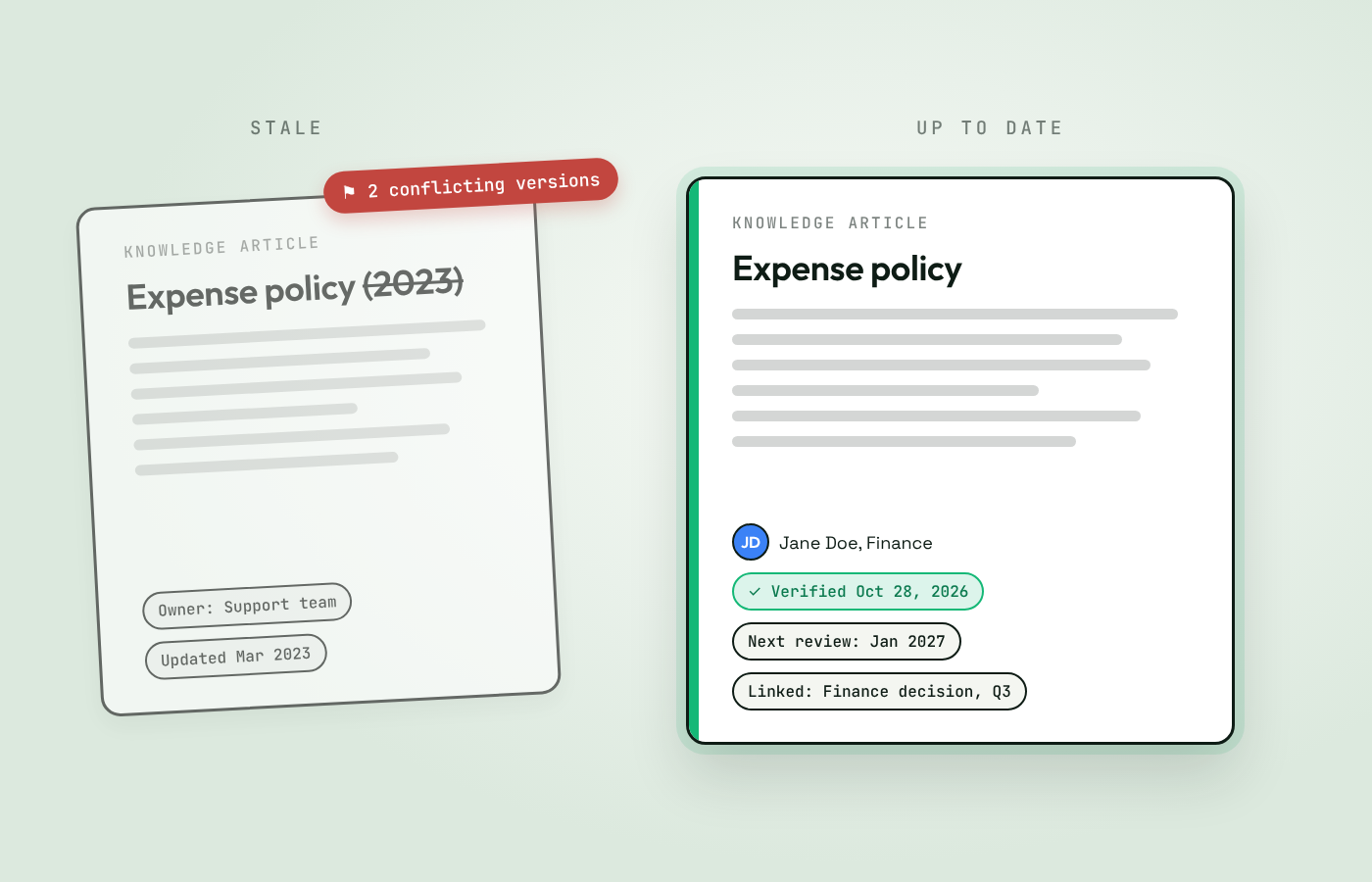
How to Keep Your Knowledge Base Up to Date (and Stop It From Going Stale)
Knowledge bases go stale fast. How to keep yours up to date with owners, review dates, updates in the flow of work, and signals that flag outdated content.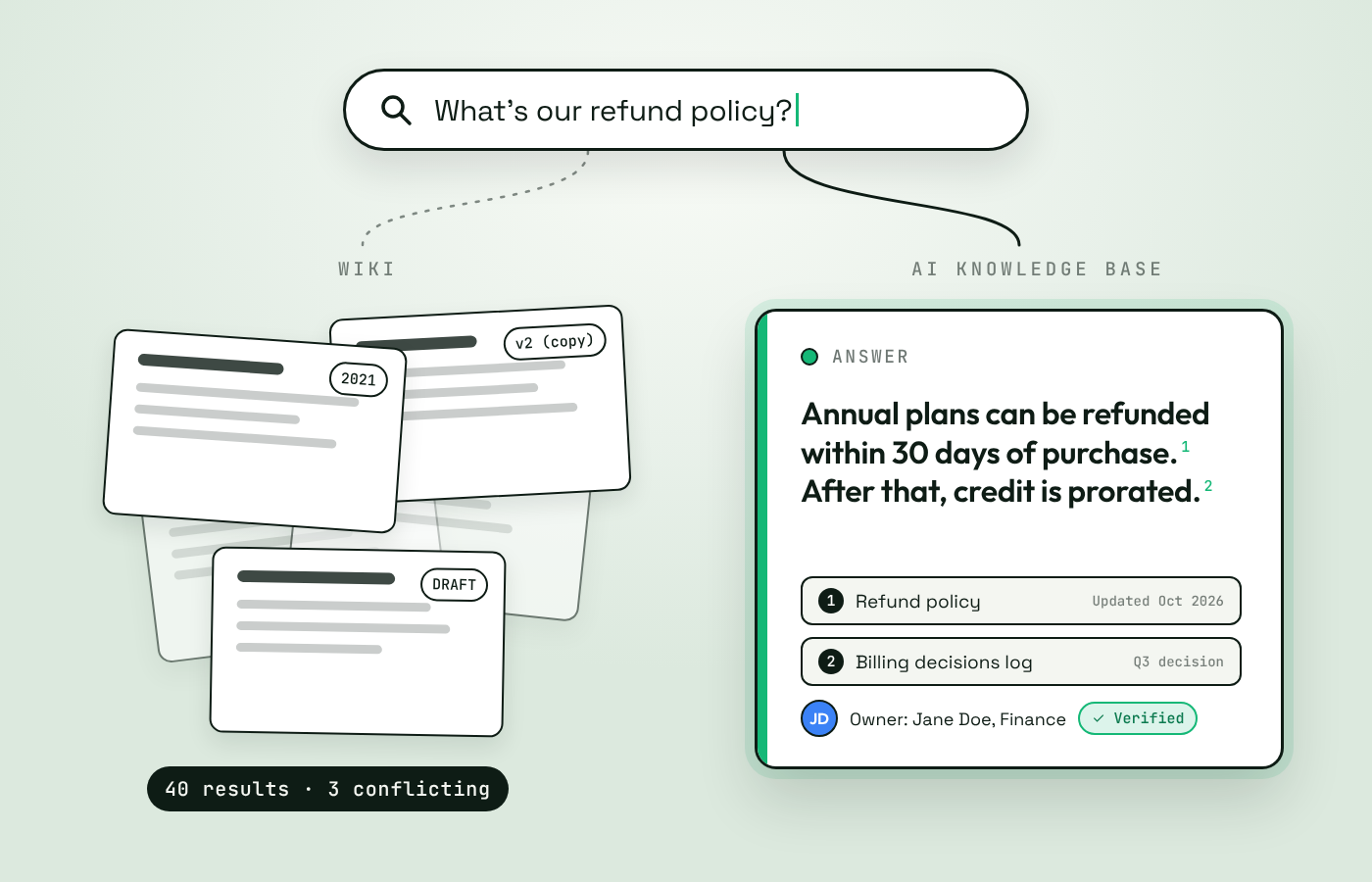
AI Knowledge Base vs Wiki: Should You Replace Your Company Wiki?
AI knowledge base vs wiki: how they differ, what AI changes, the real risks, and a five-question test for whether to replace, upgrade, or keep your wiki.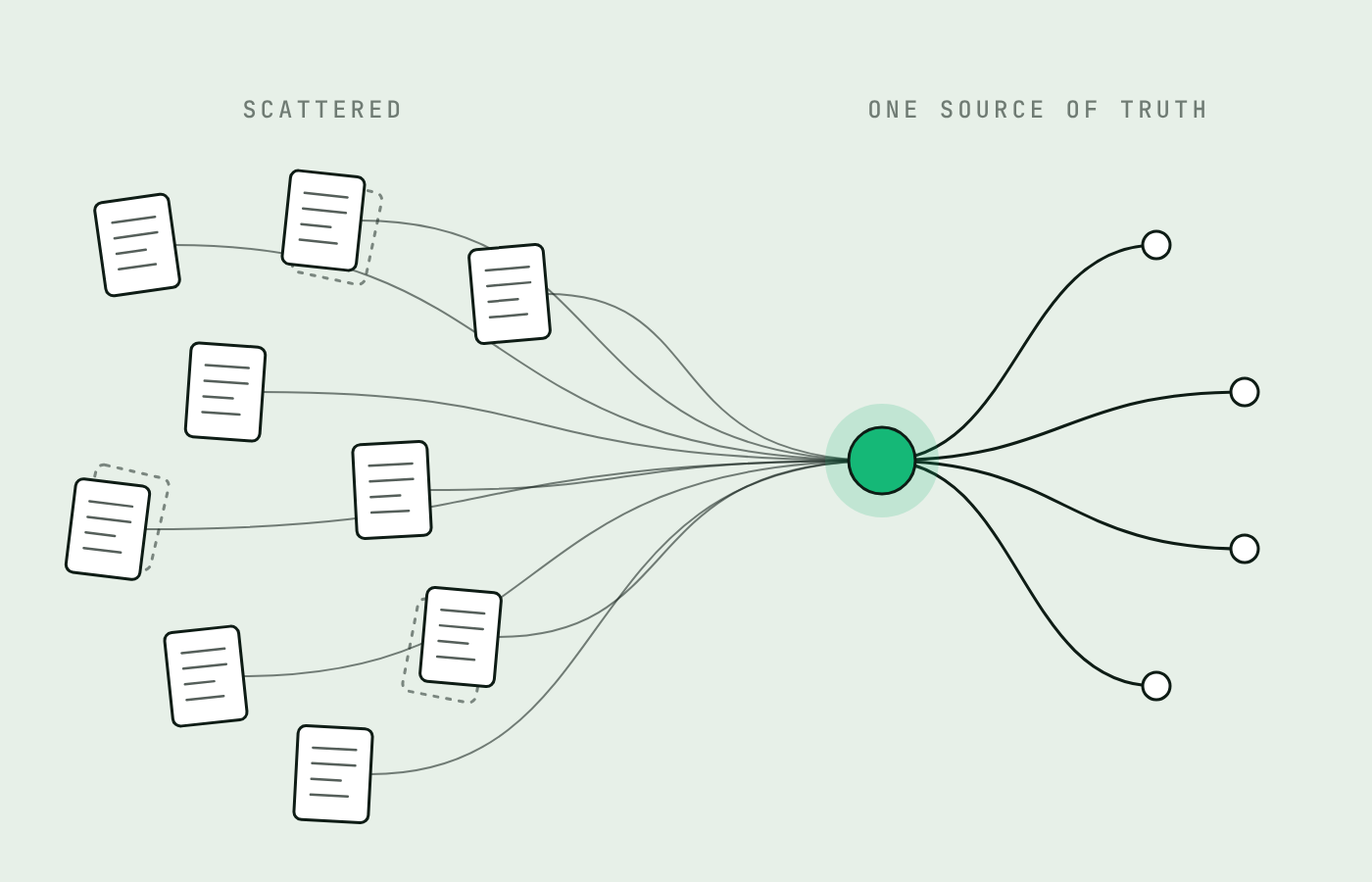
How to Build a Single Source of Truth for Your Company (7 Steps)
A single source of truth gives every important question one trusted answer, for people and AI. How to build one in seven steps and keep it current.


