Article
Customer Evidence: What It Is and How to Use It in Product Management
Customer evidence is traceable proof from real customers behind product decisions. Learn the types, how to grade it, and how to put it to work.

“Customers are asking for this” might be the most expensive sentence in product management. Sometimes it’s true. Often, it’s one loud account, one memorable call, or a sales rep’s best guess on how to land an account. The difference between the anecdote and reality is evidence.
In this guide, I’ll explain what customer evidence is, how it differs from feedback and insights, how to judge whether it’s strong, and how to use it in product roadmap decisions. I’ll also walk through an example.
What is customer evidence?
Customer evidence is any signal from real customers that can be traced to its source and used to inform a product decision. Take note: the key words are “traceable” and “decision.” A quote without customer attribution, a date, and a question attached is an anecdote. That same quote, linked to a specific decision, is true evidence.
Every piece of customer evidence answers four questions:
- What was observed? The specific quote, ticket, metric, or behavior.
- Who said or did it? The related customer, account, or segment.
- When and where? The actual date and the source, such as an interview, support ticket, sales call, or survey response.
- What decision does it inform? The real question, opportunity, or roadmap item it supports or refutes.
If you can answer all four of these questions, you have evidence. If you can answer only the first, you have raw feedback. So, keep going.
Customer evidence vs feedback vs insights
Feedback is raw input, insights are interpretations, and evidence is the actual material that backs a decision. The three are related, but not interchangeable. Mixing them up is how teams end up with confident roadmaps built on weak data.
Here’s how to properly classify these terms, with specific examples:
| Term | What it is | Example |
|---|---|---|
| Customer feedback | Unprocessed input from customers | “Exporting reports takes forever.” (support ticket) |
| Customer evidence | Feedback or behavior linked to a decision, with its source and context | 14 tickets from mid-market accounts in Q3 cite slow exports, and the median export takes 48 seconds |
| Customer insight | An interpretation drawn from several pieces of evidence | Mid-market admins export weekly for board reporting, so the speed of an export comes up in renewal conversations |
| Product decision | A choice the team makes, backed by insights and evidence | Prioritize faster exports, with email delivery, in Q1 |
Insights without evidence are guesses – just with good grammar. Further, evidence without decisions is a research archive that nobody will reference. The value comes from connecting all four of these.
The main types of customer evidence
Customer evidence splits along two lines: 1. what customers say versus what they do, and 2. qualitative versus quantitative. Nielsen Norman Group calls the first split attitudinal versus behavioral research. Specifically, it says that attitudinal research “is limited by what people are aware of and willing to report” (NN/g).
Common types of customer evidence include:
- Interview evidence: this includes quotes and stories from discovery or usability interviews. It’s strong on “why,” and weak on “how many.”
- Support evidence: often includes ticket volumes, tags, and quotes from your support tools. It surfaces how often a problem occurs, but is biased toward the users who are vocal and complain.
- Sales evidence: this includes win-loss notes, objections, and call transcripts. It is strong on buying criteria, but biased toward your deals in the pipeline.
- Survey evidence: this includes NPS comments, exit surveys, and in-app polls, among other signals. It can reach scale, but is often shallow in context.
- Behavioral evidence: includes product analytics, feature adoption, task completion, and churn data. It shows what people actually do, but not why they do it.
- Market evidence: this includes public reviews, community threads, and stories from customers who switched from a competitor to your solution.
The same NN/g guide notes that qualitative methods are better for answering questions about why or how to fix a problem. By contrast, quantitative methods are better for answering “how many” and “how much” questions. Ultimately, you need both.
How to tell whether your customer evidence is strong
Strong customer evidence is specific, recent, from the right segment, and confirmed by more than one independent source. On the other hand, weak evidence is vague, dated, from one loud customer, or seen in only one channel.
To talk through the strength of customer evidence on more objective terms, use this simple grading scale:
| Grade | What it means | Example |
|---|---|---|
| A: Strong | Several source types agree, they’re from the right customer segment, and the evidence was provided within the last 90 days | Interviews, tickets, and usage data all show the same export problem in mid-market accounts |
| B: Moderate | One source type, and it includes several customers from the right segment | 6 of 8 interviews mention export problems |
| C: Weak | One customer or one channel provides evidence, or it’s older than six months | One enterprise champion asked for faster exports last spring |
| D: Anecdote | Evidence has no source or date or is provided secondhand | “Sales says everyone wants this.” |
The A grade reflects a research principle called triangulation. NN/g quotes the Encyclopedia of Research Design, which defines it as “the practice of using multiple sources of data or multiple approaches to analyzing data, to enhance the credibility of a research study” (NN/g). When interviews and analytics point the same way, you can trust the signal more than either one alone.
Watch for three common biases with customer evidence:
- Recency bias: the last call or anecdote feels representative of the whole market.
- Revenue bias: one large account’s request drowns out patterns across many smaller accounts.
- Channel bias: support data overrepresents the feedback from the most frustrated and vocal users, and sales data overrepresents the opinions of prospects.
How product teams use customer evidence
Product teams use customer evidence to choose which problems to solve, to set roadmap priorities, and to confirm whether shipped work moved the needle. It shows up at three points: before a decision, at the decision, and after delivery.
Before a decision: discovery. Evidence identifies opportunities worth pursuing. Teresa Torres’s opportunity solution tree, for example, places customer opportunities between a business outcome and potential solutions. She recommends three to four story-based customer interviews before starting your first tree, because “opportunity solution trees are nearly impossible to create when you don’t have good inputs” (Product Talk).
At the decision: prioritization. Evidence is attached to items on the roadmap, so stakeholders can see why something ranks where it does. With all else equal, a roadmap item with grade A evidence should beat one with grade D evidence.
After delivery: learning. Evidence helps to close the loop. After the feature ships, did ticket volume drop? Did adoption improve in the target customer segment? New evidence either confirms the decision or pushes the team to reassess it.
Teams skip the middle step most often. While evidence gets gathered in research, a decision gets made in a meeting. Then, the link between the decision and evidence is never documented.
Where customer evidence should live
Customer evidence should live where it can be found quickly and easily, and where decisions are made. Those are often two different tools, which is the root of most problems with cataloging evidence.
While it’s one thing to store the information and make it searchable, it’s another to connect it to the decisions it informed. That’s why many teams combine a repository with their record of decision-making: a simple log where each decision includes context and the evidence behind it.
Some platforms are built to hold that link directly. NuHQ Products connects customer evidence, product decisions, roadmaps, and releases in one system, so the quote that justified a roadmap item stays attached through release. Learn more about how it works on the NuHQ Products Tour.
What using customer evidence looks like in practice
In practice, every significant decision has a short, sourced evidence summary that anyone who needs to learn more about it can reference.
Here’s a hypothetical example:
A 40-person B2B software company is deciding whether to build a Salesforce integration in Q1. The head of sales says, “every prospect asks for it.” Before committing two engineers for a quarter, the product manager pulls the customer evidence:
- Sales evidence: of 30 lost deals in the last two quarters, 7 mention the missing Salesforce integration in win-loss notes (grade B).
- Interview evidence: in 6 interviews with current customers, 2 mention it, both enterprise accounts (grade C for mid-market).
- Behavioral evidence: 41% of active accounts use the CSV export weekly, and most of those files are imported into a CRM within an hour (grade B).
- Support evidence: 19 tickets in the last 90 days ask about syncing with a CRM (grade B).
Combined, that’s A-grade evidence for a problem related to CRM sync. However, it’s only C-grade evidence that Salesforce is the right answer for mid-market customers. So, the team ships a scheduled CRM export first. Then, it measures ticket volume and deal outcomes before committing to a full integration.
The decision is now explainable and defensible. Six months later, a new VP can open the roadmap item and see the 7 lost deals, the 19 tickets, and the usage data behind it.
How to build a habit with customer evidence
Make evidence the default input to every roadmap conversation, rather than an optional appendix. Small rules, applied consistently, win over a large research program that nobody follows.
Here are five practices that work:
- Require a source for every claim. In planning meetings, “customers want X” gets a follow-up: “Which customers, and where did we hear it?”
- Grade evidence out loud. Use the A-to-D scale in conversation, so that conversations (and disagreements) are about the strength of evidence – not the seniority of the person talking.
- Attach evidence to decisions, not documents. Link the quote or metric to the item on the roadmap or record of the decision.
- Set a freshness window. Prioritize more recent feedback. For example, review and re-test evidence that’s older than six months.
- Close the loop. After launch, add the data related to the outcome to the same record.
Evidence is also far more useful when it sits alongside product context, strategy documents, and past decisions. That’s the idea behind building a single source of truth for your company.
See evidence and decisions in one place
Take the NuHQ Products tour to see how customer evidence, decisions, roadmaps, and releases stay connected, with no sales call required. To see how well information moves throughout your company today, take the free Sync Index, or join the waitlist for our private beta.
Key takeaways
- Customer evidence is traceable proof from real customers, with a source, a segment, a date, and a linked decision.
- Feedback is raw input, whereas evidence is feedback or behavior tied to a decision. Insights are interpretations of customer evidence.
- The strongest evidence combines what customers say with what they do, and it’s confirmed by more than one source.
- Grade evidence from A to D, so that teams debate its strength, not each other’s opinions.
- Evidence is most valuable when it stays attached to the decision in whichever tools you’re using, and alongside the release it shaped.
Put this into practice with NuHQ Products
Product work linked to the decisions and knowledge behind it. The beta is opening to teams in waves.
Frequently asked questions
What is customer evidence?
Customer evidence is any traceable signal from real customers, such as interview quotes, support tickets, notes from sales calls, survey responses, or product usage data, that’s used to support or challenge a product decision. It’s different from opinions because each piece of customer evidence can be traced back to a source, a customer or segment, and a date.
What is the difference between customer evidence and customer feedback?
Customer feedback is raw input: what customers tell you through tickets, surveys, calls, and reviews. On the other hand, customer evidence is feedback or behavioral data that has been linked to a specific question or decision and assessed for its strength. Feedback becomes evidence when someone uses it to argue for or against a choice and can show where it came from.
What are examples of customer evidence?
Common examples include interview quotes, recordings of usability sessions, the volume of support tickets by theme, churn reasons, win-loss notes from sales calls, feature usage analytics, and NPS comments. The strongest evidence combines what customers say with what they actually do – ideally from several independent sources that point the same direction.
How much customer evidence do you need to make a decision?
It depends on how costly and reversible the decision is. For example, a small change that’s easy to undo might need only one strong signal. On the other hand, a major roadmap bet should have evidence from at least two independent sources, such as interviews and usage data, across more than one customer segment. The goal is to reduce risk, not to reach certainty.
Where should customer evidence be stored?
Store customer evidence where decisions are made, not only where your team’s research is analyzed. A research repository makes evidence findable, but evidence is most useful when it’s linked directly to the decision, roadmap item, or release it supports, so that anyone can later see why the team made a choice.
Sources
Written by
LinkedIn profileRelated reading
How to Audit Your Software Stack (Before Your Next Renewal)
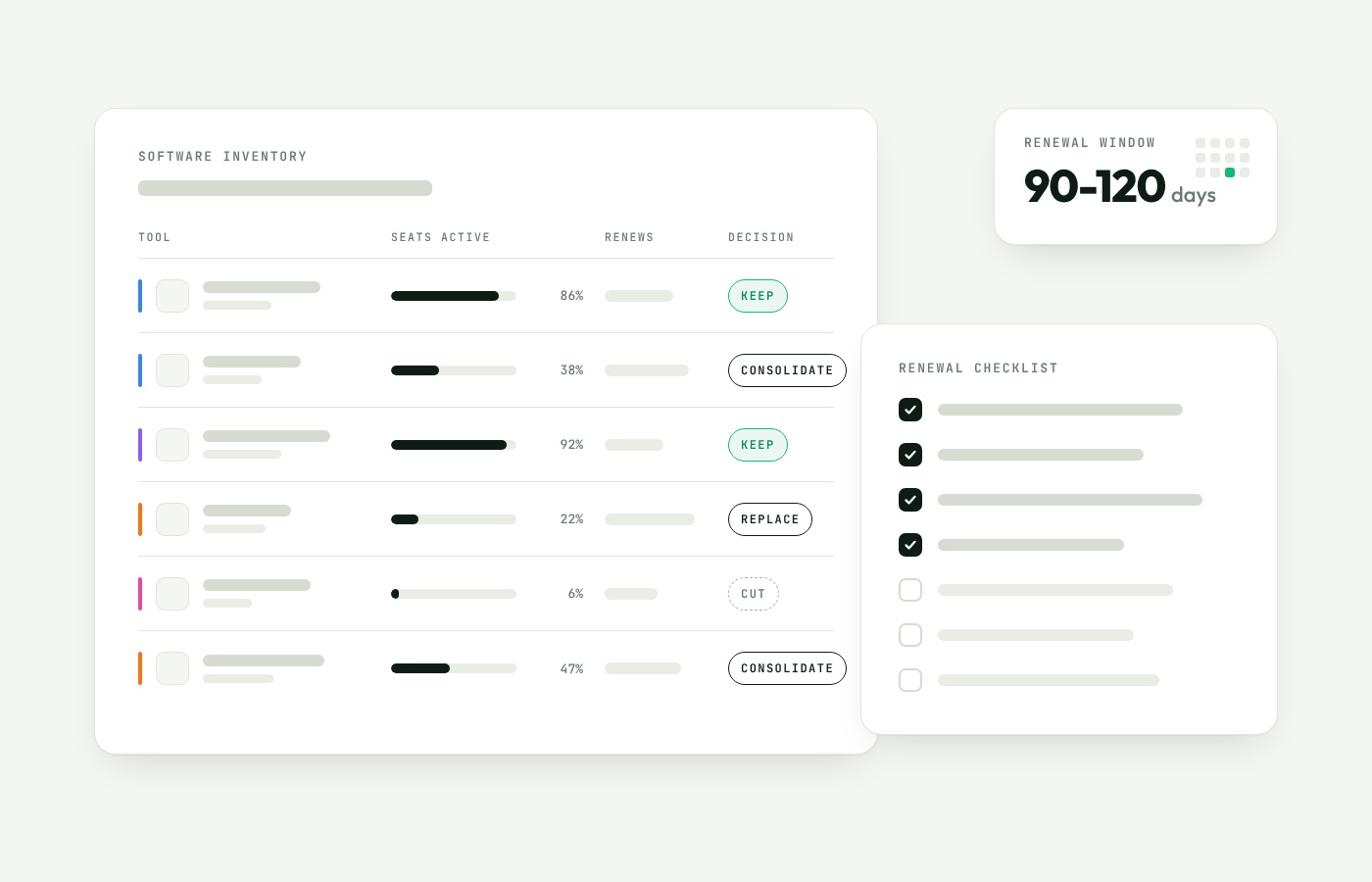
A practical guide to auditing your software stack: build an inventory, find overlap and unused seats, check true costs, and plan renewals. Checklist inside.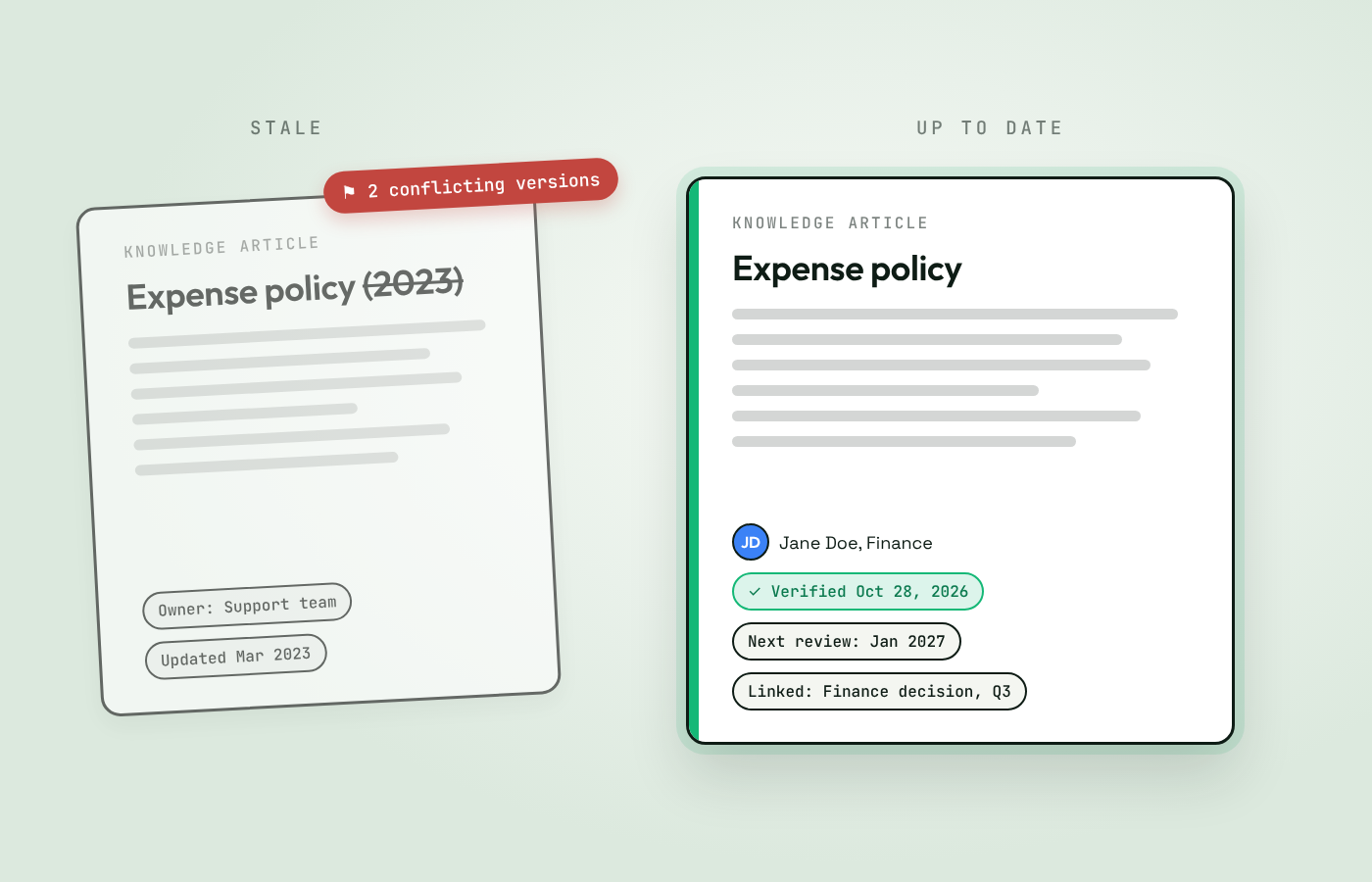
How to Keep Your Knowledge Base Up to Date (and Stop It From Going Stale)
Knowledge bases go stale fast. How to keep yours up to date with owners, review dates, updates in the flow of work, and signals that flag outdated content.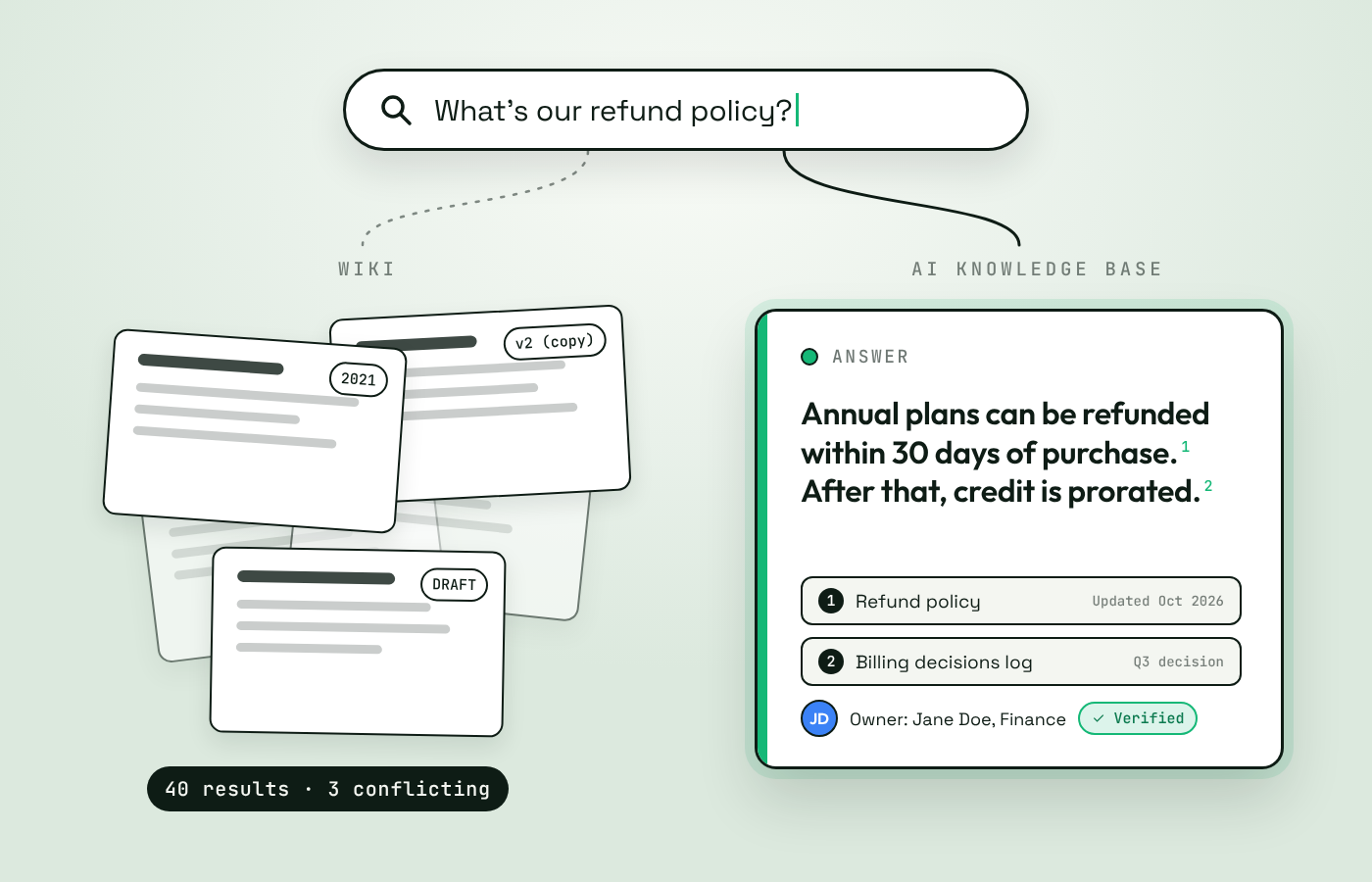
AI Knowledge Base vs Wiki: Should You Replace Your Company Wiki?
AI knowledge base vs wiki: how they differ, what AI changes, the real risks, and a five-question test for whether to replace, upgrade, or keep your wiki.


